ARS²™ Framework · Retail & CPG technology readiness
Transparency builds trust.
Trust accelerates adoption.
ARS² helps retailers, CPGs and solution providers understand what technology can deliver accurately, repeatedly, at scale, and with speed.
Make demonstrated capability visible. Understand what is still developing. Align on what comes next.
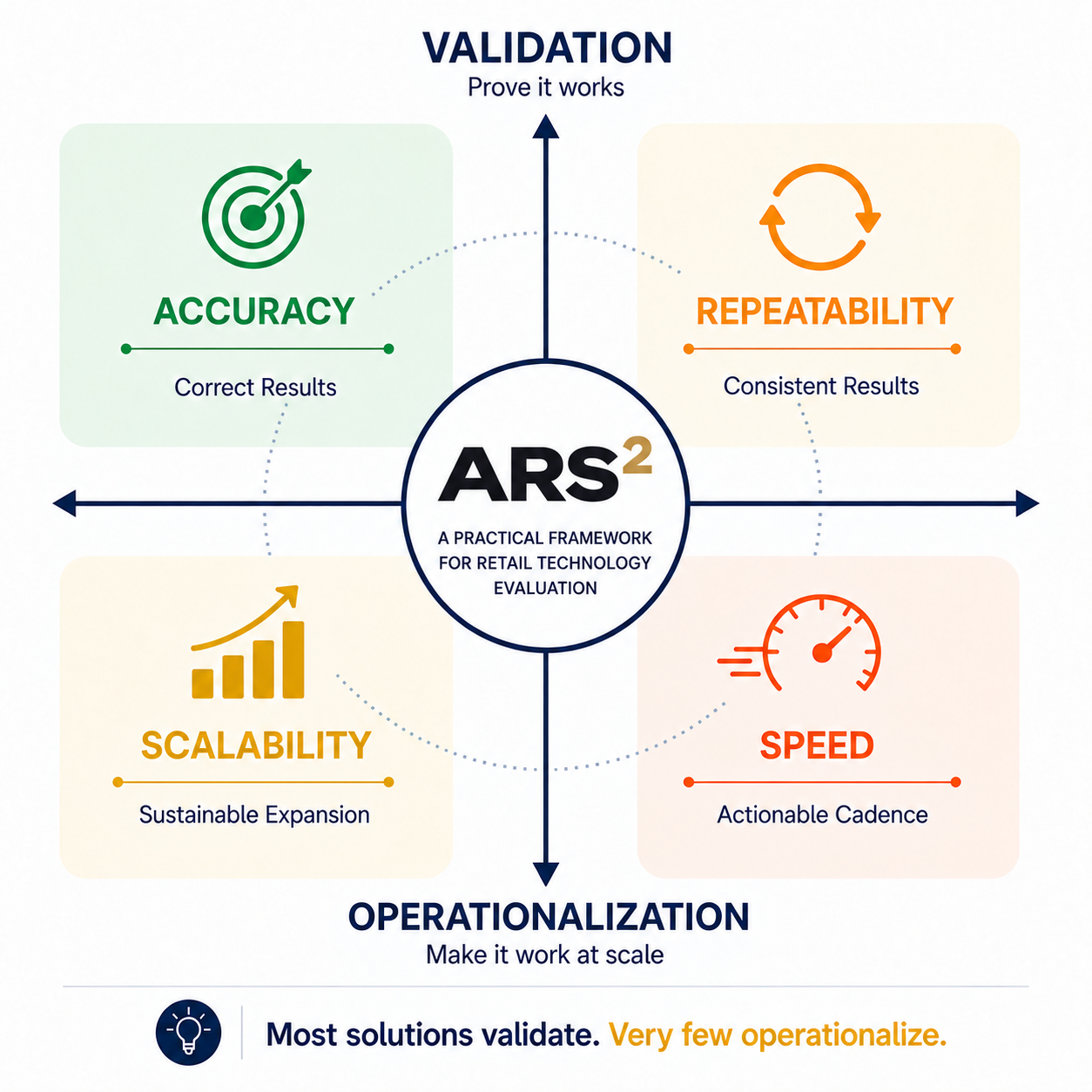
A practical framework for evaluating retail and CPG technology readiness.
Why ARS² exists
Close the Innovation
Transparency Gap.
The gap is the distance between what the market believes a solution can consistently deliver and what it has demonstrated under real operating conditions.
ARS² makes that gap visible. It helps organizations understand what has been proven, what is still developing, and what it will take to move forward.
That applies to established solutions as much as emerging ones. AI is resetting the capability baseline. Differentiated data and disciplined delivery increasingly determine whether those capabilities create operational value.
“Established is a market position. Proven is an operational condition.”
The framework
Look beyond the demo.
Understand operational readiness.
A successful pilot answers one question. An operational deployment raises many more. ARS² brings structure to that conversation through four connected dimensions.
Accuracy
Does the solution produce correct and usable results under real-world conditions, including variability and edge cases?
What is measured? Against what reference? Under which conditions?
Repeatability
Can performance be reproduced consistently over time, across locations and through operational change?
How consistent are results? Where do they vary? What changes over time?
Scalability
Do performance, cost and operational effort hold as the footprint, assortment and complexity grow?
What has been deployed? What resources are required? Where are the limits?
Speed
Are results generated, delivered and acted on at the cadence the use case requires?
How long does it take? How current is the information? When can action follow?
Measures and thresholds are defined for the use case. ARS² supports transparency and shared understanding; it does not rank vendors or imply certification.
What ARS² delivers
- A structured language for discussing retail technology readiness.
- A transparent framework for evaluating operational maturity.
- Alignment across retailers, CPGs and solution providers.
- A repeatable method for communicating innovation progress.
Maturity, made visible
Progress is a conversation.
Make it a measurable one.
Exploring, Developing, Progressing and Achieving provide a shared vocabulary for discussing maturity across the four dimensions.
Exploring
Prove the concept and clarify what needs to be demonstrated for the defined use case.
Developing
Develop capability through pilots and gather evidence against agreed measures.
Progressing
Expand deployment with reliability and address gaps as operational evidence grows.
Achieving
Operate consistently at scale against the agreed requirements for the defined use case.
Maturity is assessed for each dimension within the defined use case. Levels are not comparative across solutions; they can differ by dimension and change over time.
Put ARS² to work
Start with the decision.
Choose the depth you need.
Define the operational objective, agree on relevant sub-KPIs, examine the evidence and revisit readiness as products and deployments evolve.
How ARS² works
ARS² creates a clear, consistent path from evaluation to operational impact.
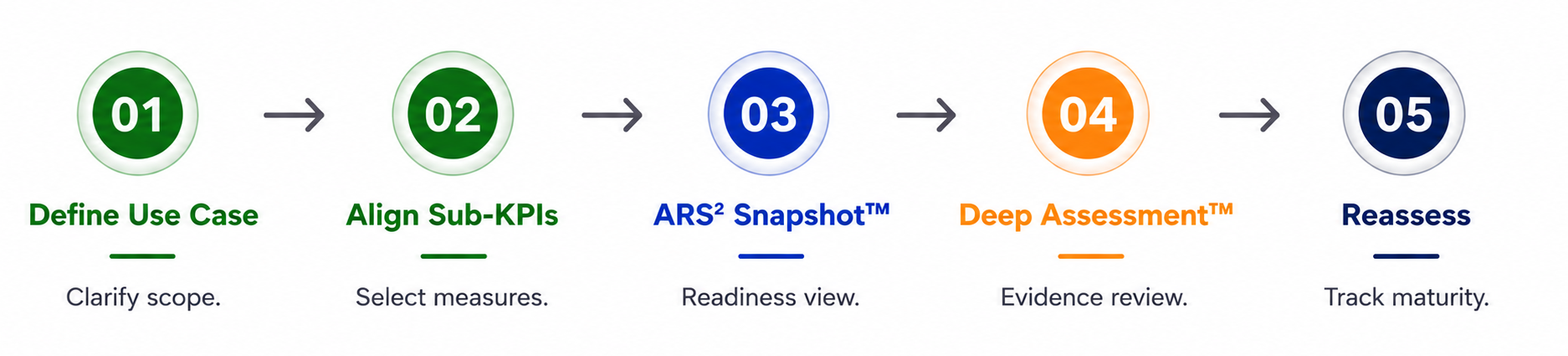
- Define Use Case: Clarify the operational objective and evaluation scope.
- Align on Sub-KPIs: Identify relevant measures across the ARS² dimensions.
- ARS² Snapshot: Establish a lightweight readiness assessment.
- Deep Assessment: Examine supporting operational evidence.
- Ongoing Reassessment: Track maturity as products and deployments evolve.
ARS² Snapshot™
A high-level readiness view across the four dimensions. Create a common starting point and identify questions that need deeper exploration.
ARS² Deep Assessment™
A use-case-specific assessment using agreed sub-KPIs and supporting evidence. Understand demonstrated capability, limitations and the path forward.
ARS² Advisory
Ongoing reassessment as products, data and deployment scale change. Keep decisions and communication aligned with operational progress.
A shared lens. Different decisions.
Retailers
Understand fit before expanding deployment.
Align technology, category and operations teams on what has been demonstrated in the environments where the solution must work.
CPGs
Connect technology readiness with business requirements.
Evaluate how a solution supports category, shopper and execution decisions, with measures that reflect your data needs and operating cadence.
Solution providers
Communicate capability with greater clarity.
Show what has been demonstrated, explain the limits of the evidence and make the next steps in product and deployment maturity visible.
ARS² has been applied in discussions and self-assessments involving computer vision, robotics, shelf intelligence, inventory automation, planogram compliance and consumer signal technologies.
ARS² in practice
See how providers describe
their own readiness.
ARS² is an independent framework for transparent evaluation and communication of technology readiness. These six original self-assessments were shared through the ECR CatManNetwork Tools & Technology Group initiative. Each pairs the provider’s use case and maturity view with its perspective on applying ARS².
Each assessment is specific to its use case and date. Levels are not comparative across solutions. These provider self-assessments are distinct from an evidence-backed Deep Assessment.

Provider self-assessment
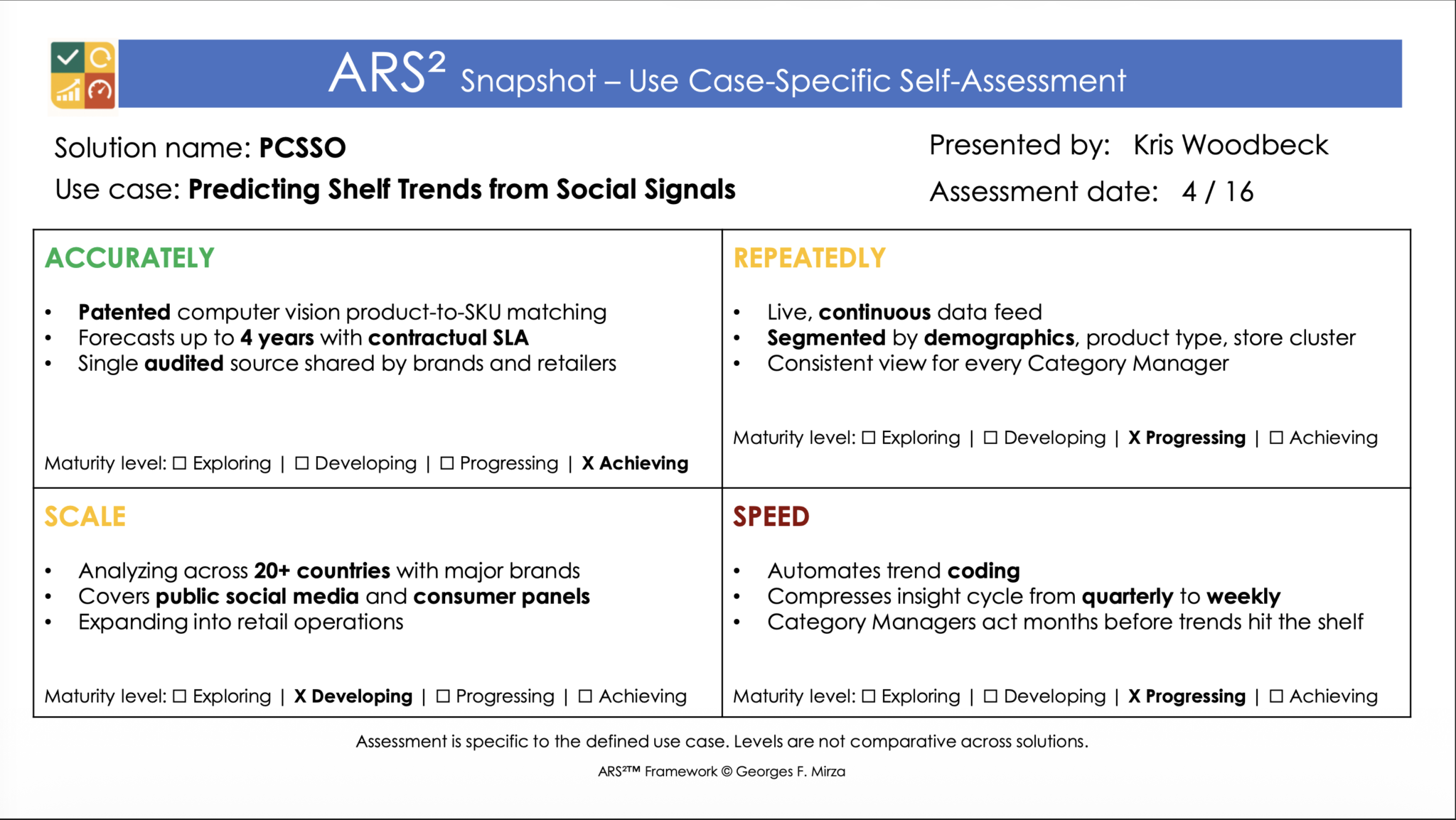
PCSSO
Predicting Shelf Trends from Social Signals
Assessment date: 4/16 (as shown on the original slide)
“ARS² helps shift innovation discussions away from hype and toward real-world readiness.”
Use case: Predicting Shelf Trends from Social Signals.
Self-reported maturity: Accuracy: Achieving. Repeatability: Progressing. Scale: Developing. Speed: Progressing.
The original slide contains the provider’s supporting statements and limitations. These are historical self-assessments for the stated use case, not independent verification of current performance.

Provider self-assessment
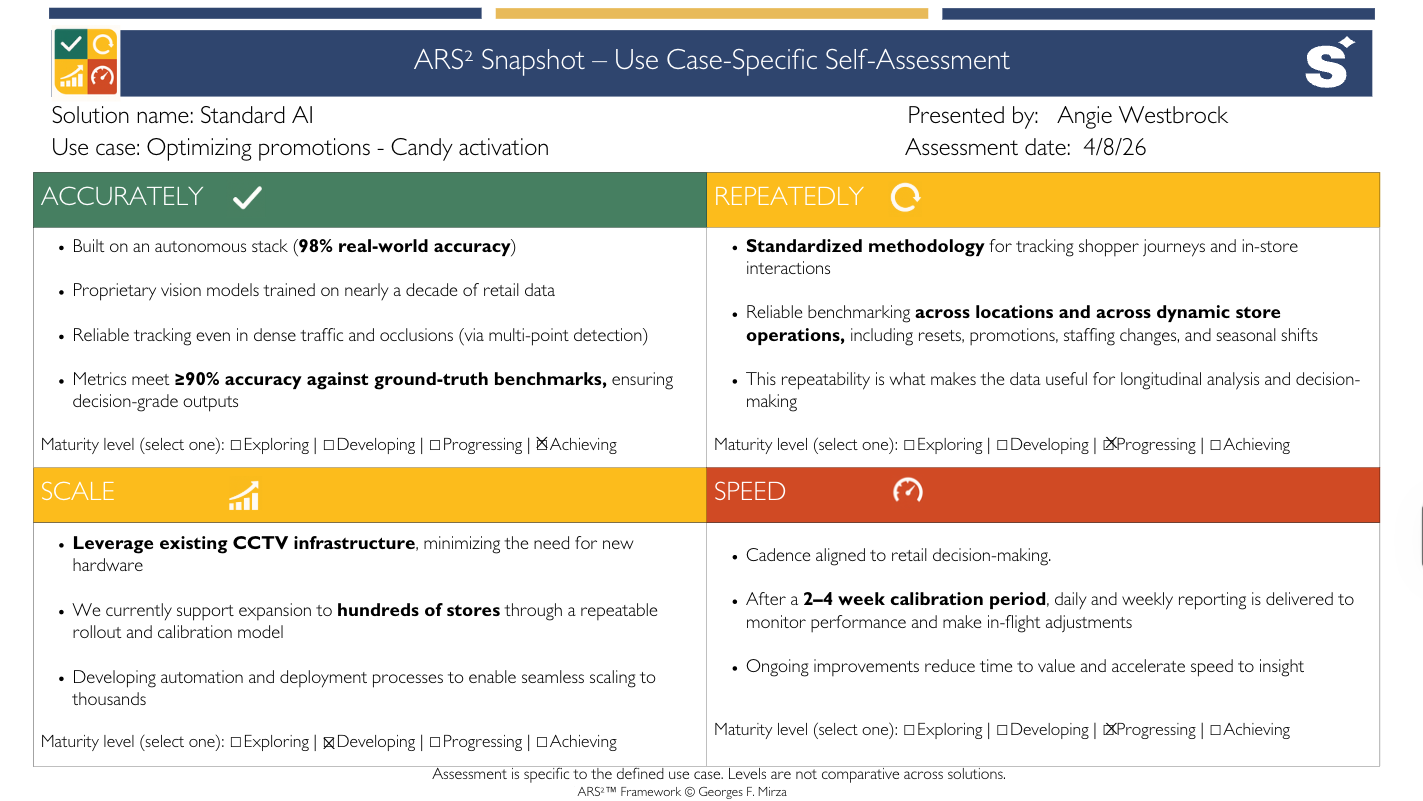
Standard AI
Optimizing promotions — Candy activation
Assessment date: April 8, 2026
“ARS² creates a common language for evaluating technology readiness in a transparent and measurable way.”
Use case: Optimizing promotions — Candy activation.
Self-reported maturity: Accuracy: Achieving. Repeatability: Progressing. Scale: Developing. Speed: Progressing.
The original slide contains the provider’s supporting statements and limitations. These are historical self-assessments for the stated use case, not independent verification of current performance.

Provider self-assessment
Simbe
Real-time shelf visibility across a retail chain
Assessment date: April 28, 2026
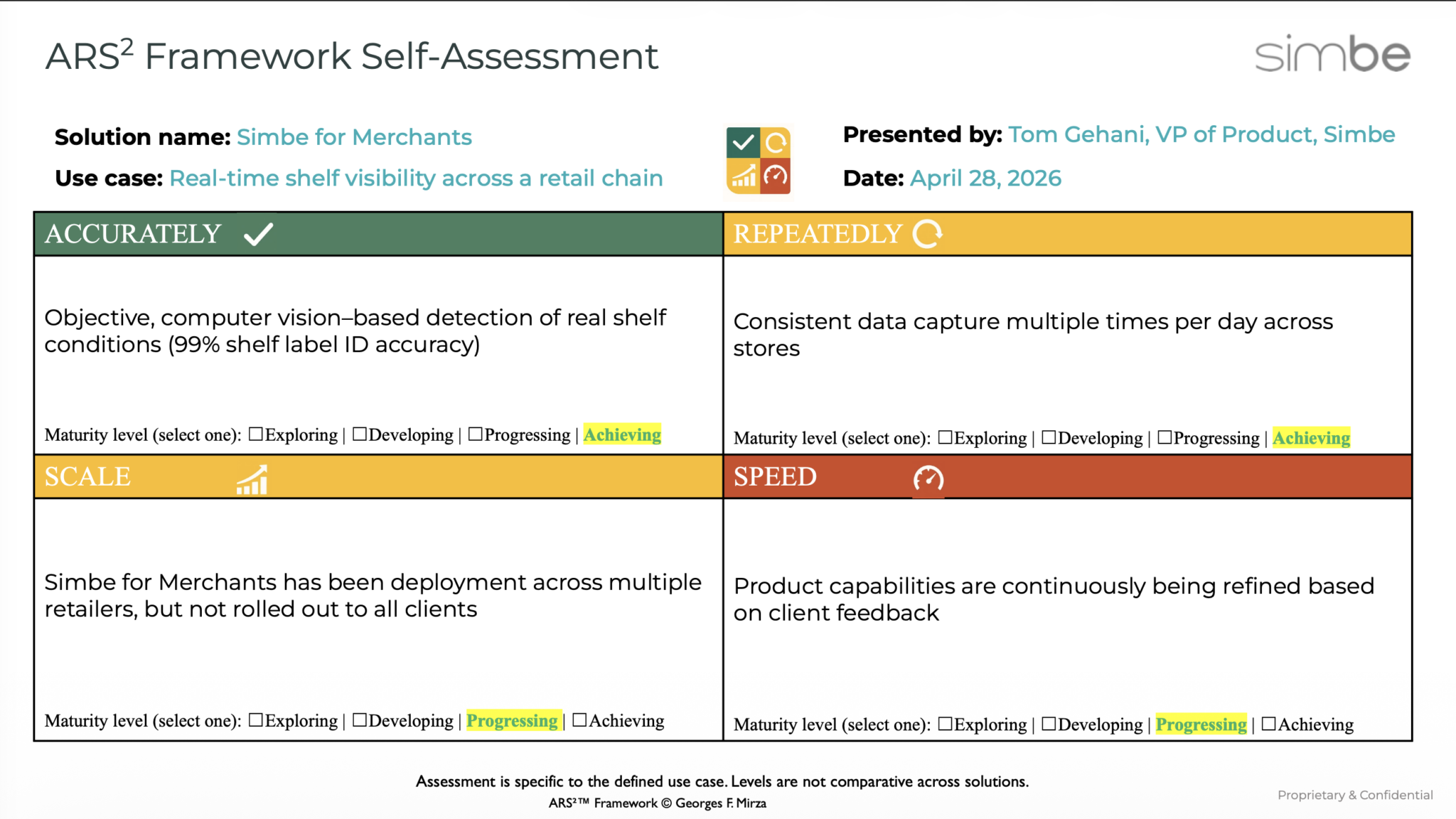
“Achieving the best outcomes through innovation often means making intentional choices and trade-offs. ARS² is a framework that helps the most innovative retailers get a clear understanding of those trade-offs to move fast, confidently.”
Use case: Real-time shelf visibility across a retail chain.
Self-reported maturity: Accuracy: Achieving. Repeatability: Achieving. Scale: Progressing. Speed: Progressing.
The original slide contains the provider’s supporting statements and limitations. These are historical self-assessments for the stated use case, not independent verification of current performance.

Provider self-assessment
CoolR
Out-of-Stock Detection & Automated Actions
Assessment date: June 19, 2026
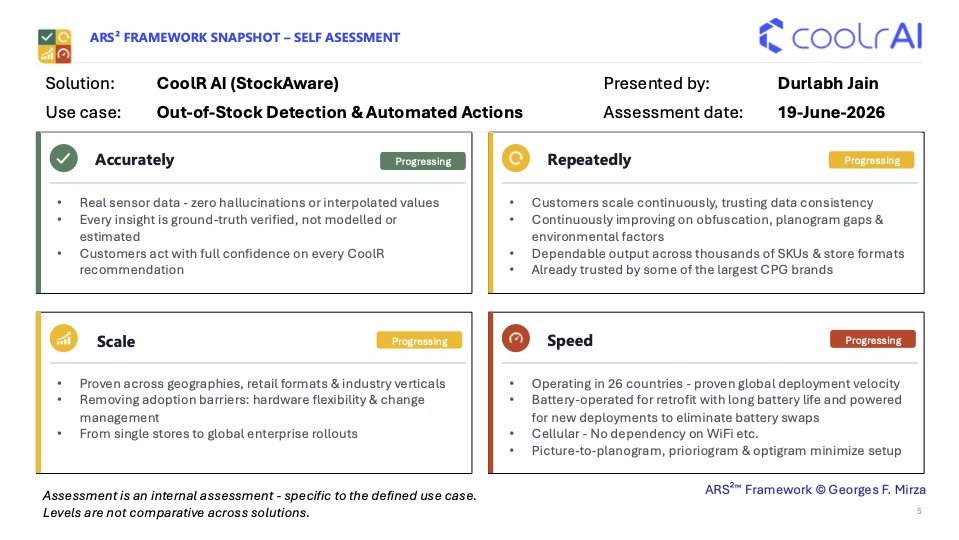
“ARS² pushed the conversation beyond detection and shelf visibility. It helped us reframe the challenge from “can we see the shelf?” to “can we execute on it reliably, at scale, every time?””
Use case: Out-of-Stock Detection & Automated Actions.
Self-reported maturity: Accuracy, Repeatability, Scale and Speed: Progressing.
The original slide contains the provider’s supporting statements and limitations. These are historical self-assessments for the stated use case, not independent verification of current performance.

Provider self-assessment
Panasonic Connect Europe
Reliable, Flexible, Agnostic Product Recognition Service
Assessment date: June 30, 2026
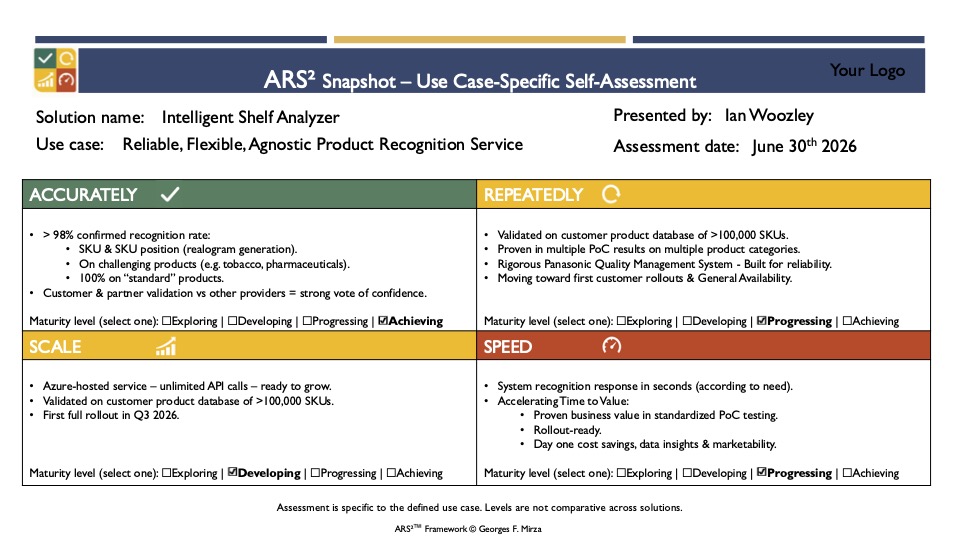
“Using the ARS² Framework as a lens to present Panasonic’s Shelf Analyzer service was a valuable exercise. It helped us assess our progress toward providing a robust product recognition engine for end users and partners, while applying impartial rigor informed by industry experts.”
Use case: Reliable, Flexible, Agnostic Product Recognition Service.
Self-reported maturity: Accuracy: Achieving. Repeatability: Progressing. Scale: Developing. Speed: Progressing.
The original slide contains the provider’s supporting statements and limitations. These are historical self-assessments for the stated use case, not independent verification of current performance.

Provider self-assessment
Hoffrogge
Mass-adaption of Picture Of Success to individual outlets
Assessment date: June 30, 2026
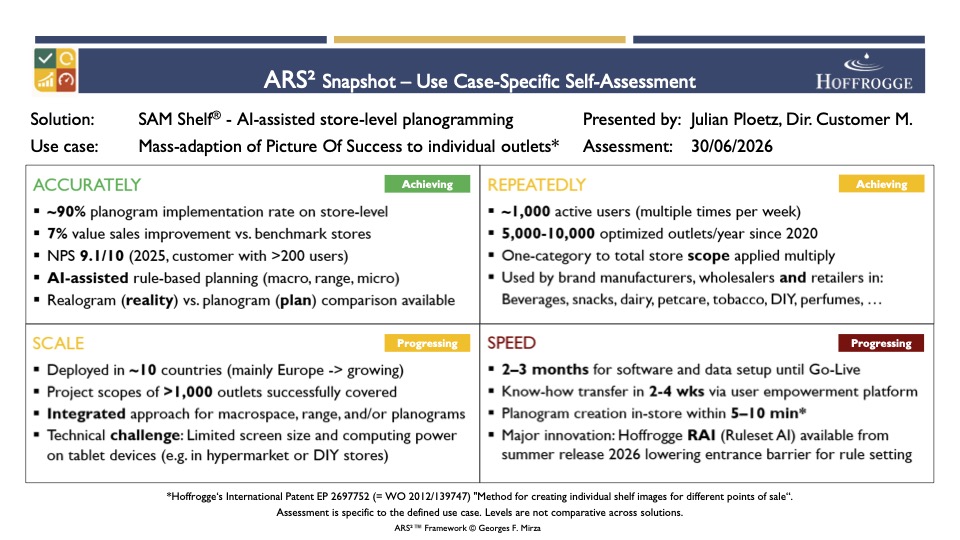
“ARS² helped us clearly position Hoffrogge’s software, communicate readiness, and build trust with decision-makers by showing how scalable planogram adaption can deliver real business value.”
Use case: Mass-adaption of Picture Of Success to individual outlets.
Self-reported maturity: Accuracy: Achieving. Repeatability: Achieving. Scale: Progressing. Speed: Progressing.
The original slide contains the provider’s supporting statements and limitations. These are historical self-assessments for the stated use case, not independent verification of current performance.
What would a transparent readiness discussion look like for your solution?
The thinking behind ARS²
From real-world experience
to a shared industry lens.
These publications develop the framework’s core ideas: operational readiness, transparency, trust, and the discipline required to turn innovation into value.
RetailWire · Foundational article
The four operational measures, their origins in real deployments, and their role in rebuilding trust.

Automated Warehouse · Robotics
Applying ARS² to shelf-scanning robotics, from accurate data capture to timely action in live stores.

CPGMatters · Transparency
The Innovation Transparency Gap and why transparency matters alongside maturity, modesty, courage and vision.
CPGMatters · Baselining
Why established does not mean proven, and how differentiated data and disciplined delivery shape operational value.

ECR CatManNetwork · Category management
Connecting persistent category management challenges with evaluation under today’s operating conditions.
“Innovation moves at the speed of trust, not at the pace of technology.”Georges Mirza · The Fifth Trait Missing from Successful Innovation
Industry perspectives & engagement
Others are advancing
the conversation.
Industry perspectives connect ARS² with technology evaluation, editorial coverage and the human side of adoption.
“ARS² is long overdue and has the potential to become a best-practice standard for evaluating retail technology innovation.”
The timing of this is perfect! The non-stop flood of new retail tools and technologies has created a very difficult task for retailer and CPG decision makers charged with evaluating the viability, relevance and likely ROI on technology investments for their organizations. An organizing and objective tool for this evaluation is essential.
The ARS² framework, created by Georges Mirza, provides a simple but very effective way of determining the current status, future potential and fit for any retailer or CPG organization. It provides a transparent way for evaluating a tool, new or legacy, against the criteria that will determine its real value. ARS² is long overdue and will become the best practice standard to evaluating all retail tools and technologies. Thank you Georges for this very valuable contribution to the industry.
I strongly urge all retailers and CPG organizations to take advantage of the significant benefits the ARS² framework provides.
How far should you trust your next tech innovation?
James Tenser explains ARS² and CPGMatters’ plans to use it as a knowledge framework and editorial lens for technology coverage.

Two reliable paths to startup innovation
ShiSh discusses ARS² alongside Microsoft’s Well-Architected Framework as complementary lenses for solution performance and technical readiness. His article is an author perspective.

Codify how you lead
Jordan Jones references ARS² while exploring how making working methods visible supports a more transparent leadership practice. His article is a personal perspective and does not represent H-E-B.
Tools & Technology Group
ARS² has been introduced within the group to bring transparency to discussions of innovation maturity. The original self-assessments above are part of that initiative.
A structured approach to retail & CPG innovation
Coverage of the ECR Community’s Tools & Technology Group and its approach to examining emerging solutions.
Created by Georges Mirza
Built from experience.
Focused on transparency.
ARS² connects technology claims with the operational questions retailers and CPGs need answered.
Created by Georges Mirza, a global retail and CPG product and technology strategy advisor, the framework provides a shared language for discussing demonstrated performance and innovation maturity.
A few practical questions
No. It supports a transparent discussion of readiness in a defined use case. A Snapshot, self-assessment or participation in an industry discussion does not imply certification or independent verification.
Yes. The same operational questions apply to emerging and established solutions. The scope and measures should reflect the decision, use case and deployment conditions.
A self-assessment records the provider’s view of its readiness. A Deep Assessment examines use-case-specific sub-KPIs with supporting evidence. The source, scope and date of evidence should be clear in either case.
Start with the technology or use case you are evaluating, the decision you need to make and the operational requirements that matter. Those define the scope and relevant measures.
Move the conversation forward
What does readiness mean
for your use case?
Let’s define the questions, the evidence and the next step.

Transparency builds trust.
Trust accelerates adoption.
© 2026 ComTask LLC. All rights reserved.